 Steinbach
Poolrunner Twin
- Fully automatic or manual cleaning mode
- Integrated filter system
- "Weekly Timer" for individually settable cleaning period
Sold Out
The selected product is currently not available. As soon as the product is on stock, we will send you an E-mail.
Product information
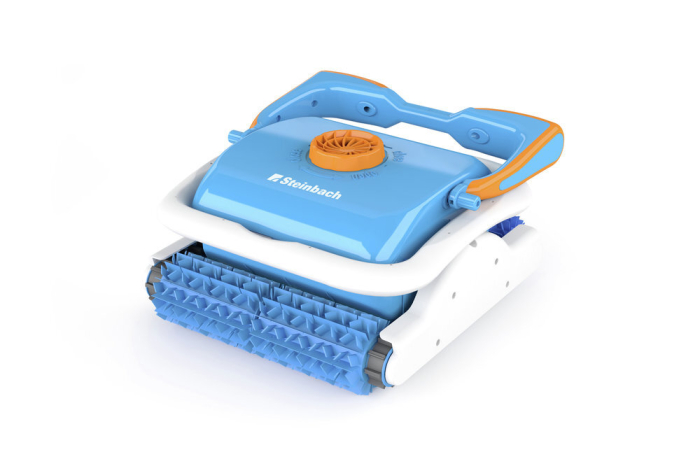
The Poolrunner Twin is a fully automatic swimming pool cleaner. The "Weekly Timer" can be used to define the time interval at which cleaning should start. The swimming pool cleaner is specially designed for optimal floor and wall cleaning of your swimming pool. Special plastic brushes clean both the floor and the wall. With the integrated filter unit, combined with a 20 V, 20.000 l/h strong high-performance pump, a connection to an external filter system is not necessary. The control is fully automatic. The cable connected to the vacuum pool cleaner and control unit is approx. 18,00 m long. This allows easy cleaning for pool sizes up to 50 m².
ATTENTION! No suitability for overflow-, stainless steel-, tile pools, as well as pools with an air ring.
Pool runner:
Operating mode: control unit with cable, automatic cleaning
Cleaning area: floor cleaning, wall cleaning, waterline
Suitable for saltwater: yes
Pump capacity: 20.000 l/h
Width of cleaning element: 361 mm
Speed: 12 m/min
Immersion depth: 2 m
Filter mesh: 100 μm
Safety class: IPX8
Water temperature: 10°C - 35°C
Ambient temperature: 10°C - 40°C
Pool size - floor area: 50 m²
Connection:
App control: no
Connection type: no
App name (APP store): nein
Control unit:
Cable length to the device: 18,00 m
Control unit rated power: 200 W
Control unit energy power: 220-240V~ / 50Hz
Control unit output voltage: 20 V
Control unit safety class: IPX5


FAQs from category Pool robots:
Do not leave the cable in the pool all the time. After each use, remove it from the pool and unplug and turn off the cord. Wash the cable with clean water to remove chemical residues after each cleaning operation. Put the cable length into the pool according to pool dimensions, place the remaining cable at the pool edge, i.e. pull overflown cable out of the water. Place obstacles such as built-in pool ladders/installation ladders out of the pool to prevent the cable from getting caught.
Position the power supply so that the cleaner can easily reach all areas. Switch off the filter pump while cleaning with the pool vacuum. Enter the maximum possible length of the connection cable in the pool, but take into account a corresponding minimum distance between the control unit and the pool. Change the setting of the nozzles.
Clean the filter container/filter bag and remove slippery debris such as algae from the pool walls. Put the pool vacuum cleaner into the pool at the optimum water temperature. This is between 10°C and 35°C. Check the drive belts and brushes for wear and replace them if necessary. Set the PH value correctly. This should be between 7.0 and 7.2. Switch off the unit and let all the air escape. Mount the additional buoyancy aids from the scope of delivery.
Check the plug of the power cord and the control unit or the battery. Plug the control unit directly into a socket and do not use extension cables. Check your house line for overload, the socket may be defective. Contact a qualified electrician.
There is air in the pool vacuum, switch off the unit, let all the air escape and let the pool vacuum sink to the ground. If necessary, adjust the salt content correctly.
Check the wheels/drive belts for wear and foreign objects in the drive. Replace the wheels/drive belts if necessary.
Check whether the water level in the pool is too high and drain the water if necessary. If your pool liner is a little rough, the pool vacuum will have more grip. Carry out a reduction of the buoyancy. If you have a salt water pool, the buoyancy is slightly higher in salt water; reduce the buoyancy.
It is necessary to weigh down the pool vacuum cleaner. A weight must be installed for this purpose. Please contact our Service Centre.
Our pool vacuums were designed for liner pools, the above materials have no grip or adhesion for the pool vacuum because the surfaces are too smooth.
Pull the cleaning hose and lift the automatic vacuum pool cleaner from the pool floor. The pool floor may be wrinkled, preventing the vacuum cleaner from moving. Check the water flow and make sure that the filter pump is switched on and has the appropriate power. Make sure that the gate valves are open. Clean or change the filter cartridge. For sand filter systems, you must backwash the filter.
You need to unblock or remove the cleaning lips because the sail, water outlet nozzle or cleaning lip may be stuck.
The buoyancy aids must be glued onto the inside of the upper part of the device - ideally offset and not directly next to each other.
The pool robot beeps when the ON/OFF button is pressed outside the water. This is due to the integrated water sensor. Put the pool robot into the water and after 15 seconds it will start cleaning the pool.
Press the ON/OFF button on the underside of the pool robot until you feel it click into place. If the ON/OFF button is pressed outside the water, the device beeps and does not switch on due to the integrated water sensor. Place the pool robot in the water. Please note: The pool robot only starts cleaning 15 seconds after it has been placed in the water.
All pool robots from Steinbach and INTEX are suitable for salt water as long as the salt content in the water is below 0.5 % (salt electrolysis). Clean the pool robot thoroughly with clear water after each use. (Info: This removes chlorine and salt water residues - so the material is preserved for a long time and also does not fade as quickly).